Collections
Overview
A collection is just a directory on your file system which may or may not contain requests in the .posting.yaml format.
There's absolutely nothing special about a collection. It contains no "special files" or metadata -- it's just a directory. It could even be empty. "Collection" is simply the name we give to the directory which we've loaded into Posting.
The collection browser
Posting displays the currently open collection in the sidebar. This is called the collection browser.
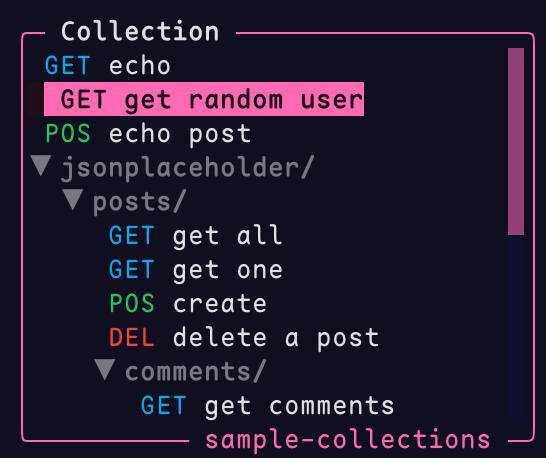
The name of the currently open collection is displayed in the bottom right corner of the collection browser. In the example above, the collection is named "sample-collection".
You can navigate this sidebar using the keyboard or mouse. Open a request by clicking on it or pressing Enter while it has focus, and it'll be loaded into the main body of the UI. A marker will also appear to the left of the request's title, indicating that the request is open. A save operation will overwrite the currently open request.
Keyboard shortcuts
The collection browser supports various keyboard shortcuts for quick navigation. For example Shift+J and Shift+K can be used to jump through sub-collections. Press F1 while the browser has focus to view the full list of shortcuts.
The collection browser can be moved to the left or right side of the screen by setting the collection_browser.position configuration option
to either "left" or "right".
The default collection
If you launch Posting without a --collection argument, it will load the default collection, which is stored in Posting's reserved data directory on your file system.
The default collection can be thought of as a system wide collection.
It's a place to keep useful requests that you can easily access from anywhere, without having to manually specify a --collection argument.
You can check where this is by running posting locate collection.
The default collection is named "default", that name will be displayed in the bottom right corner of the collection browser.
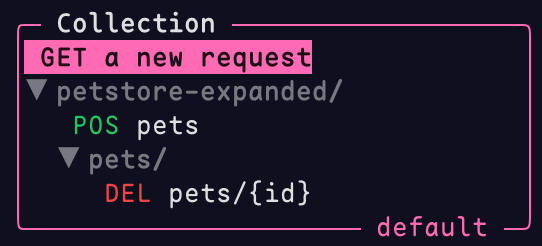
This is useful to get started quickly, but you'll probably want to create your own collection directory and load it instead. This makes it easier to organize your requests and check them into version control.
Creating a collection
A collection is just a directory, so you can create a collection by simply creating an empty directory anywhere on your file system.
With the directory created, it's time to load it into Posting...
Loading a collection
If you want to load a collection, you can do so by passing the path to the collection directory to Posting:
posting --collection path/to/collection
Example
To open a collection (a directory containing requests), use the --collection option:
posting --collection path/to/collection
This will recursively find and display requests in the sidebar.
If you don't supply a directory, Posting will use the default collection directory.
You can check where the default collection is by running posting locate collection.
Request and response history
The History tab in the collections sidebar keeps recent exchanges, newest first.
Each entry shows the sent method, status, URL, and local time. Click an entry or
highlight it and press Enter to load its saved request configuration and response.
This replaces the current editor contents. Moving the highlight alone does not load
anything. Loading never sends a request, runs scripts, or changes the session's cookies.
Request snapshots include the method, URL, headers (including disabled rows), body, query/path parameters, authentication, metadata, options, and script paths. They are captured before variables are resolved and scripts run, so variable expressions and script references remain editable. Scripts are references to files relative to the collection, not archived copies. Missing scripts do not prevent loading; resending reports the existing script-loading error. Changed variables or scripts can change what gets sent next time.
Loaded requests are detached from collection files. Ctrl+S opens the save dialog
instead of overwriting whichever collection request was open previously. Older history
entries that were recorded without a request snapshot still load their response and
show an explanatory notification; their request configuration cannot be recovered.
A source line identifies the saved response and its timestamp, including in compact mode. Response Scripts and Trace are unavailable because their output is not retained. The request's Scripts tab still contains its saved script references. Sending another request returns the Response pane to its normal live view.
Keyboard and jump mode
If the sidebar is hidden, show it with Ctrl+H first.
- Press
Ctrl+O, then4to activate the History tab. - Press
Downorjto move from the tabs into the history list. - Use
Up/Downork/jto highlight an entry;g/Gselects the first/last. - Press
Enterorlto load that request and response. Focus stays in the list. - Edit the request as needed and press
Ctrl+Jto send it explicitly.
With History already visible, Ctrl+O, then h jumps directly to the list. The h
target appears only when the list is visible and nonempty. Ctrl+O, then 3 activates
Requests; Down enters its tree (or use Ctrl+O, then Tab when that tree is visible).
When the sidebar tabs have focus, Left/Right or h/l switches between them. These
keys are context-specific: h in jump mode targets history, while l in the list loads
an entry. Escape cancels jump mode and returns focus to where it was.
Press Backspace in the history list to delete an entry. Ctrl+Backspace clears the
current collection's history after confirmation. Press F1 in the list for help.
Local storage
History is stored in SQLite files under $XDG_DATA_HOME/posting/history/ (normally
~/.local/share/posting/history/), separate from your collection files. Each collection's
absolute, resolved path identifies its history, so moving a collection starts a new
history. Posting retains at most 100 exchanges and 50 MiB of request/response data per
collection, pruning the oldest entries automatically. An exchange larger than 50 MiB
is still displayed but is not saved, and Posting shows a notification.
The database contains request configuration, response bodies and headers (including cookies), status, and timing. Auth values, headers, bodies, and URLs can contain secrets: history is local, unencrypted, and created with owner-only file permissions. Resending uses the current environment, script files, and session cookies; those dependencies are not archived. To stop saving new entries, set this in your configuration:
history:
  enabled: false
Or set POSTING_HISTORY__ENABLED=false. Existing history remains available for viewing
and deletion. Exchanges are recorded for all HTTP statuses, including errors such as
404 and 500; connection failures without a response are not recorded.